

Responding to the Global Trend of Nature-Related Risk Disclosure:NDHU Shares the TNFD Framework and Corporate Practices
With the support of President Hui-Mi Hsu, sustainability has become one of the core institutional priorities of National Dong Hwa University(NDHU). Since 2024, the University has promoted the "Flagship Project II(Sustainability)," encouraging faculty and staff to further advance sustainability-related research and practice. Building on its long-standing commitment to issues such as biodiversity and natural capital, NDHU has in recent years actively engaged in cross-sector dialogues on global sustainable finance and emerging trends in nature-related financial disclosure, reflecting President Hsu's vision of integrating sustainability into both academic expertise and everyday practice.
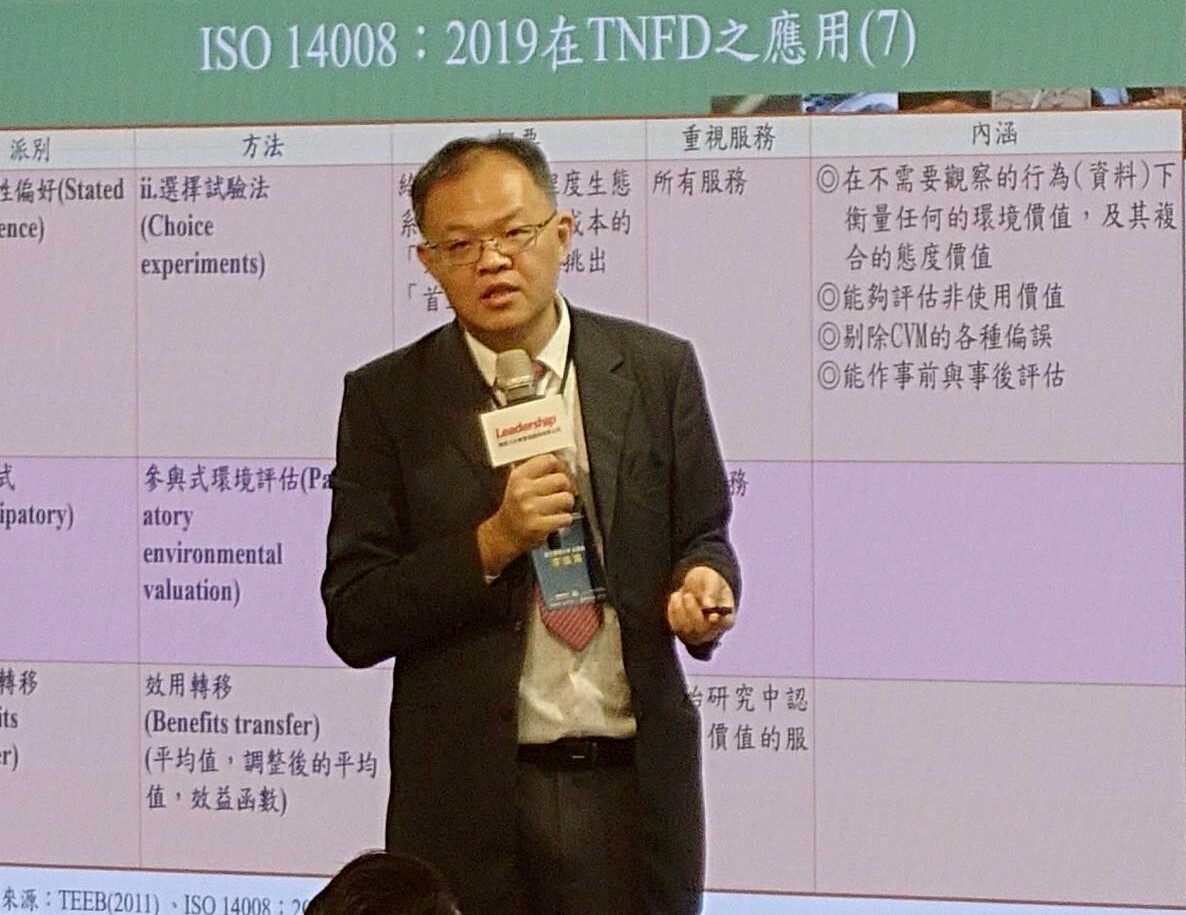
Invited by its long-standing partner, Leadership Management Consulting Co., Ltd., NDHU's Chief Sustainability Officer, Dr. Chun-Hung Lee, participated on December 17, 2025, in the "2025 Second Seminar on ISO Technical Standards and Emerging ESG Trends." Drawing on institutional experience and perspectives from higher education, Dr. Lee delivered a keynote presentation titled "An Overview of the Taskforce on Nature-related Financial Disclosures(TNFD)Framework and Its Application in Corporate Practice," exchanging insights with industry representatives on emerging trends in nature governance and sustainable management.
The one-day conference featured four major thematic sessions, exploring how ESG strategies can be integrated with nature-related governance frameworks, biodiversity, and the circular economy, thereby strengthening corporate commitments to the environmental(E)dimension of sustainability. Environmental management discussions also focused on critical issues such as carbon credits, the impacts of carbon pricing and fees, internal carbon pricing mechanisms, and greenhouse gas inventory practices. In addition, the conference provided updates on the latest developments in international standards and highlighted key directions for corporate compliance and response strategies, helping participants stay informed of evolving global regulatory trends. Beyond keynote speeches, the event included interactive "Consultant Dialogue" sessions that facilitated real-time discussion of practical challenges, fostering active engagement among participants.
Dr. Lee emphasized that the core principle of the Taskforce on Nature-related Financial Disclosures(TNFD)lies in supporting organizations to identify the interdependencies and impacts between their operations and the natural environment, assess associated risks and opportunities, and incorporate nature-related considerations into decision-making processes. Compared to climate-focused disclosure frameworks, TNFD adopts a more comprehensive approach by systematically addressing ecosystem services, biodiversity, and land- and water-related issues, carrying profound implications for future organizational governance and sustainable development.
Looking ahead, NDHU will continue to contribute its academic expertise to domestic and international sustainability dialogues, deepen collaboration with industry and broader society, and advance sustainable development in Taiwan and globally through research, education, and concrete action.